
How do you get found in AI search engines like ChatGPT?

Robert Oosterloo
Updated on · 9 min read
More and more people are no longer asking their questions to Google, but to ChatGPT, Perplexity, or the AI summaries at the top of Google. These provide one answer, along with a few sources. How do you ensure your business is included among them? The good news: most of the work is the same as regular SEO. Here you can read what really works, what you can skip, and how to measure it.
In short
- AI search engines search the web and read your website. A site that is well discoverable on Google has the best chance.
- Allow the search bots of AI services. Blocking training bots is allowed, it won’t cost you visibility.
- Write for people: clear answers, personal experience, what you do, where, and for whom.
- Special tricks like llms.txt or splitting texts for AI are not necessary according to Google.
- AI currently sends very few visitors: on average less than 1% of traffic, compared to about 25% from Google.
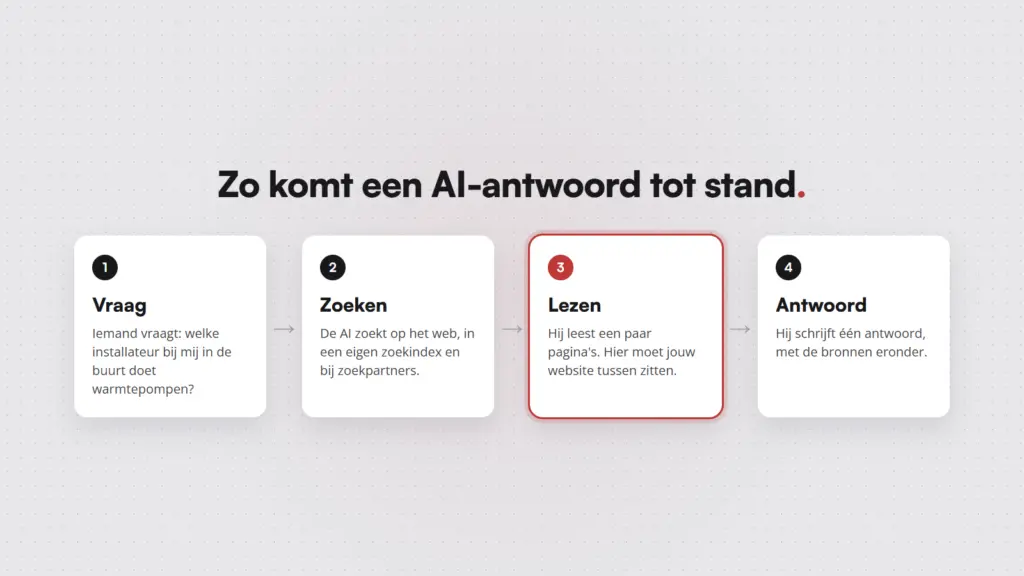
What is an AI search engine?
By AI search engines, we mean services that answer a question with a written response instead of a list of links. The most well-known are:
- ChatGPT, when searching the web.
- Google AI summaries (AI Overviews) and the AI mode of Google.
- Microsoft Copilot, built on Bing.
- Perplexity and Claude.
They work in roughly the same way. They search the web, read a few pages, and write an answer based on that. Below or in that answer are the sources. If you want to be mentioned, your page must be found during the search and contain a good answer.
How big is it really?
Smaller than many reports suggest. In a study by Ahrefs among over 118,000 websites, it was found that in October 2026 0.46% of traffic came from AI assistants, most of which was from ChatGPT. Google accounted for nearly 25%. Google is still by far the largest source of visitors.
However, AI is changing how people use Google. Research by Pew Research in the United States (2025) showed that when presented with an AI summary in Google, people clicked on a link only 8% of the time, compared to 15% without a summary. Being mentioned in that answer is therefore becoming more important, even if you continue to follow the regular search results.
Step 1: let the right bots in
Every AI service sends one or more bots (crawlers) to your website. Some are there to display your pages in search results, others to train AI models. These are different bots, and you can allow or block them separately in the robots.txt file.
- For search results: OAI-SearchBot (ChatGPT), Claude-SearchBot (Claude), and PerplexityBot (Perplexity). If you block these, you won’t appear in their answers. OpenAI explicitly states that sites blocking OAI-SearchBot will not appear in ChatGPT search answers.
- For training: GPTBot (OpenAI), ClaudeBot (Anthropic), and Google-Extended (Gemini). If you block these, you are requesting that your content not be used for training AI. According to OpenAI and Google, this does not affect your visibility in their search results.
Google AI summaries do not have their own bot: for that, Google uses the regular Googlebot. If you are in Google, you can also appear in the AI summaries.
Tip: Your leflite website allows all search bots by default. You can view your own robots.txt by typing /robots.txt after your domain name. If you see something like Disallow: / under any of the search bots above, please contact us.
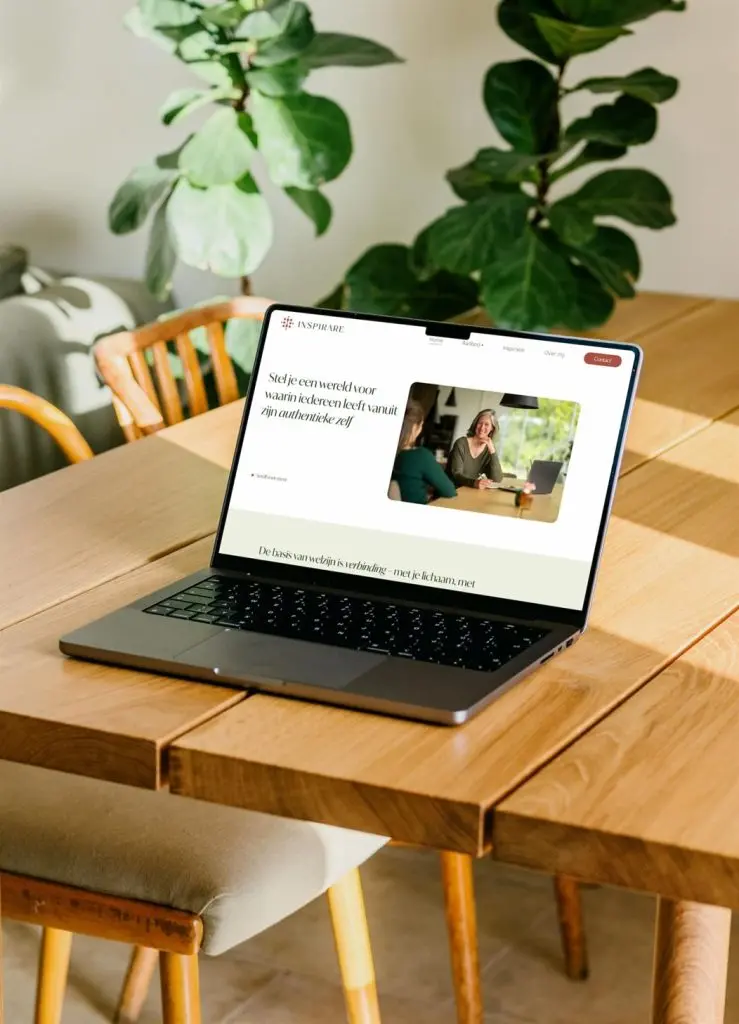
No website on leflite yet?
We will build it together with you. After that, you can adjust everything yourself, just like in this article.
- Online within a week
- Hosting, SSL, and backups included
- Starting from €49,95 per month
Step 2: ensure Google and Bing know your site
AI search engines do not build everything themselves. Google simply uses its own search index for its AI summaries: a page must be in Google to be included. OpenAI states that ChatGPT sometimes collaborates with other search services for searching. Microsoft is one of them, but OpenAI does not disclose how much ChatGPT pulls from Bing.
- Link your site to Google Search Console and submit your sitemap. You can read how that works in why your website is (still) not in Google.
- Do the same in Bing Webmaster Tools. It is free, and you can import your settings from Search Console. Bing is the basis for Microsoft Copilot.
Step 3: write for people, with real answers
In 2026, Google published its own guide on discoverability in its AI features. The core: create unique content for people, with personal knowledge and experience. According to Google, there are no extra requirements or special tricks needed to appear in the AI summaries.
What this means in practice:
- Answer your customers’ questions. What do you do, for whom, in which region, and what does it cost approximately? If those answers are not on your site, an AI cannot provide them either.
- Be specific. “We deliver quality” says nothing. “We install heat pumps in Northeast Friesland, usually within two weeks” does.
- Show what you know. Personal experience, case studies, practical examples, and real photos make your page better than a text anyone can write.
- Use clear headings. A logical structure helps both visitors and search engines. See how to use headings effectively.
- Keep your information up to date. Address, phone number, and opening hours must be correct everywhere. You can update them in one place on your website: change company details.
Step 4: ensure others talk about you
AI search engines do not only read your own website. They also use what others write about you. Think of your Google business profile, reviews, industry sites, the local newspaper, or a partner’s site. A company that is mentioned in multiple reliable places comes across as stronger.
Do this honestly. Google explicitly mentions that buying or arranging fake listings is something that does not work. Instead, ask satisfied customers for a review, and ensure that your information on each profile matches what is on your website.
Step 5: claim your business in ChatGPT
Since November 2026, you can claim your business in ChatGPT, similar to a Google business profile. In the Netherlands, you will temporarily be placed on a waiting list, and the conditions are strict. First, read our news article about Businesses in ChatGPT before you begin.
What you can skip
There are many pieces of advice circulating about AI discoverability that yield little results. Google mentions a few things in its guide that you do NOT need to do:
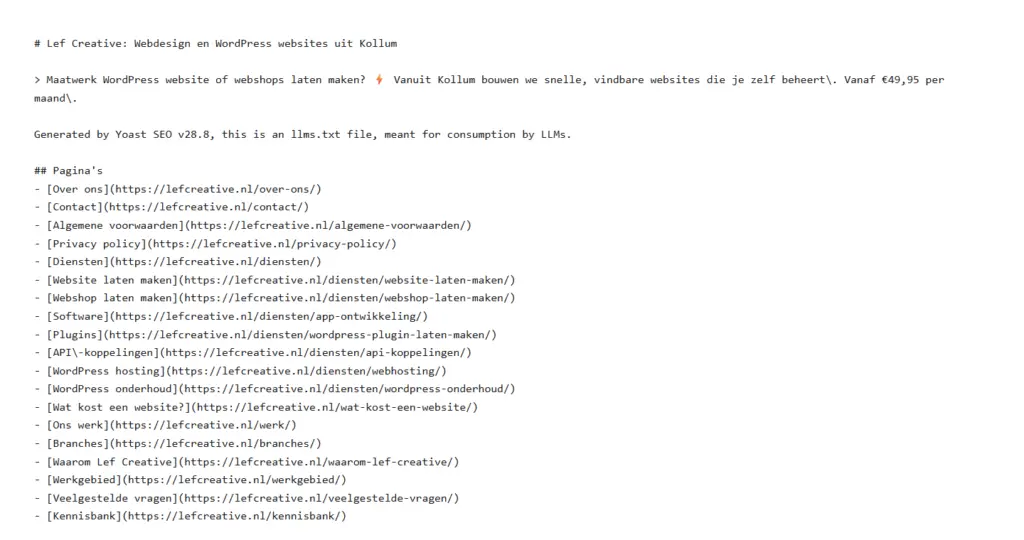
- llms.txt. A file that would provide AI services with an overview of your site. Google does not use it, and OpenAI, Anthropic, and Perplexity do not mention that they use it anywhere. Yoast SEO can create one for you. That won’t hurt, but don’t expect much from it.
- Splitting or rewriting texts for AI. According to Google, you do not need to break your content into small pieces or rewrite it specifically for AI.
- Special structured data. No special schema formatting is needed for Google’s AI features. Structured data is still useful for regular search results, and your website already adds it where it makes sense, for example, in frequently asked questions.
Note: be cautious with parties selling “AI-SEO” with guaranteed listings in ChatGPT. No one can guarantee that. OpenAI itself states that ChatGPT independently determines which companies it recommends.
Prefer not to have AI responses?
That is also possible. Since August 31, 2026, you can indicate in Google Search Console under Settings that your site should not appear in Google’s AI overviews and AI mode. Google states that this will not affect your regular search results. However, you will also not receive visitors or impressions from those AI features. For ChatGPT, Claude, and Perplexity, you can block their search bots in robots.txt. For most businesses, we advise against this: you will disappear from the places where your customers are increasingly searching.
How do you measure it?
- Google Search Console: clicks and impressions from the AI overviews count in the performance report, under the search type Web.
- Bing Webmaster Tools: has a report on AI performance, detailing how often you are mentioned in Copilot and Bing’s AI summaries. Note: a mention is not a click.
- Google Analytics: visitors from ChatGPT appear as traffic from chatgpt.com. Some come in as direct traffic, so the actual number is likely higher.
- Ask yourself: ask ChatGPT or Perplexity the question your customers would ask, for example, “which installer in my area does heat pumps?” If you are not mentioned, see which companies are and what their site does differently.
Want to know how your website is performing? Request a free website check. If you want to be found more effectively, in Google and in AI search engines, we can help you with online marketing. You can read more about findability on your own website in everything about SEO.
Sources
- Google, Optimizing your website for generative AI features on Google Search
- Google, AI features and your website
- Google Search Console Help, Search generative AI
- OpenAI, Overview of OpenAI crawlers
- Anthropic, crawlers and how to block them
- Perplexity, Perplexity Crawlers
- Ahrefs, AI vs search traffic benchmark (October 2026)
- Pew Research Center, July 2025
Frequently Asked Questions
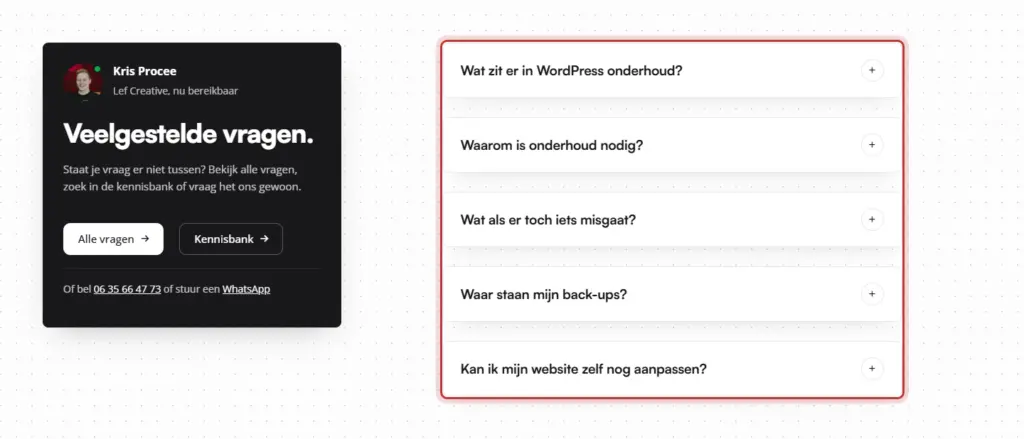
Usually not specifically. Ensure that search bots are welcome, that your site is listed in Google and Bing, and that your texts clearly answer customer questions. This works for both Google and AI search engines.
No. Training bots like GPTBot and ClaudeBot are separate from search bots. According to OpenAI and Google, blocking training does not affect your visibility in their search results.
No. Google does not use it, and none of the major AI services claim to use it. Yoast SEO can create one, which doesn’t hurt, but don’t count on it.
Share this article
Robert Oosterloo
Robert Oosterloo is eigenaar en UX/UI-designer van Lef Creative in Kollum. Hij ontwerpt websites, webshops en software voor ondernemers in Noord-Nederland.
Read also
Using the Text block
Display a breadcrumb trail
Share buttons for social media





Want a website like this?
Here you can read how easy it is to maintain a leflite site yourself. Want one too? We will think along with you, no strings attached.
Prefer direct contact? Call Robert at 06 35 66 47 73 or send a WhatsApp.